Showing posts with label Astronomy. Show all posts

Monday, September 16, 2013

Our Moon


Via Colossal (specifically, Colossal purveyor Christopher Jobson's twitter account), Kottke, and Yahoo! News blog Geekquinox, this video is made from thousands of high resolution still images from NASA's Lunar Reconnaissance Orbiter's wide angle camera.  As is somewhat common knowledge, Geekquinox notes:
The moon really does rotate, even though it doesn't look like it from here. Because the moon is 'tidally locked' to the Earth, that means that it always has one face pointed towards us. However, it also means that the time it takes to rotate once is the same as the time it takes to go around the Earth — 27 days.

Friday, September 13, 2013

We're Living in the Space Age, Dude

Beginning "I am sick of hearing people say that the Space Age is "over" because we haven't sent humans back to the Moon. Seriously? That's your complaint? ...," Annalee Newitz begins a rant at io9 on the incredible technology we now have in space and the incredible amount of knowledge we've gained.  And, indeed, we knew so little about space even a century ago that we had no concrete knowledge of the size of the universe, the amount of planets, suns, and galaxies in the universe, what in detail composed them, that there might be dark matter and dark energy, or how most of it worked. A century ago Einstein's writings on special relativity and the quantum, which are now fundamental to physics and chemistry, had only recently been published and were barely understood; his theory of general relativity was still a year away. Humans had few large telescopes, had no large rockets, and had never sent anything into space nor had any realistic plans to do so.  We now have a space station -- we've had space stations for several decades now.  Oh how things have changed.

So Newitz's article is an enjoyable rant and right.  No, we are not going today to other star systems.  Really?  Do you think that is going to happen?  This is the space age for the foreseeable future.

Newitz's rant, BTW, seems to borrow heavily in tone from Louis C.K., and he is damn funny (Newitz not so much, though that's not her point), so you should watch this:

Tuesday, February 12, 2013

Is the Asteroid About to Miss Earth an Effect of Global Warming?

Asteroid 2012 DA14 -- which is pretty big -- will be zipping within 17,000 miles of Earth on Friday -- it could even hit some satellites, though the chances of that are slim. A CNN reporter wants to know, though, if it's caused by global warming.  I'm just agog, I tells ya. Agog.


"This one's just going up and above planet Earth." Ok, I officially feel hopeless about all humanity. 

Bill Nye, meanwhile, wants us to understand that it only missed us by 15 minutes. Well, better luck next time, asteroid.

Oh, and Space.com wants us to understand that "space miners" value it at $195 billion. "Space miners"? What is that? Is that like Mole People? There are no "space miners" except in science fiction.  Jezusss.

Friday, February 8, 2013

The Minute Physics List of Great Science Sites

Henry Reich who created and produces the great YouTube channel Minute Physics (which I ought to link to more, really), has produced a list of his favorite science sites. It's actually really good (why should I be surprised?):


Here's his list:
              Youtube Channels he lists:

Sunday, February 3, 2013

"Death Valley Dreamlapse"

"Death Valley Dreamlapse" from Sunchaser Pictures on Vimeo.

This follow-up the beautiful video to "Sunchaser Star Trails" was filmed at Eureka Dunes in Death Valley National Park during the Geminid Meteor Shower Peak. It was primarily shot at 25 second interval exposures without special effects. A "UFO" appears at (1:30-1:35) and makes three broad circular sweeps over the desert and according to the filmmaker was too slow to be a helicopter (while it appears fast, due to the timelapse the period it's there is really about 50 minutes). Via Scientific American -- really!

Monday, January 21, 2013

The Largest Object in the Universe (Besides Yer Mama)

On the back of the announcement of an extraordinarily massive black hole -- the largest ever found -- in the center of galaxy NGC 1277, the discovery of a large quasar group (LQG) that is 4 billion light years across was announced last week. To quote Space.com:
To put that mind-boggling size into perspective, the disk of the Milky Way galaxy — home of Earth's solar system — is about 100,000 light-years wide. And the Milky Way is separated from its nearest galactic neighbor, Andromeda, by about 2.5 million light-years.

The newly discovered LQC is so enormous, in fact, that theory predicts it shouldn't exist, researchers said. The quasar group appears to violate a widely accepted assumption known as the cosmological principle, which holds that the universe is essentially homogeneous when viewed at a sufficiently large scale.

Calculations suggest that structures larger than about 1.2 billion light-years should not exist, researchers said.
As to the massive black hole in the center of NGC 1277, it is 17 billion times the mass of the Sun and it accounts for 14% of the total mass of NGC 1277. Normally black holes in the center of galaxies account for about .1% of their galaxy's mass.

Again, just wow.

Sunday, January 20, 2013

The Orion Bullets

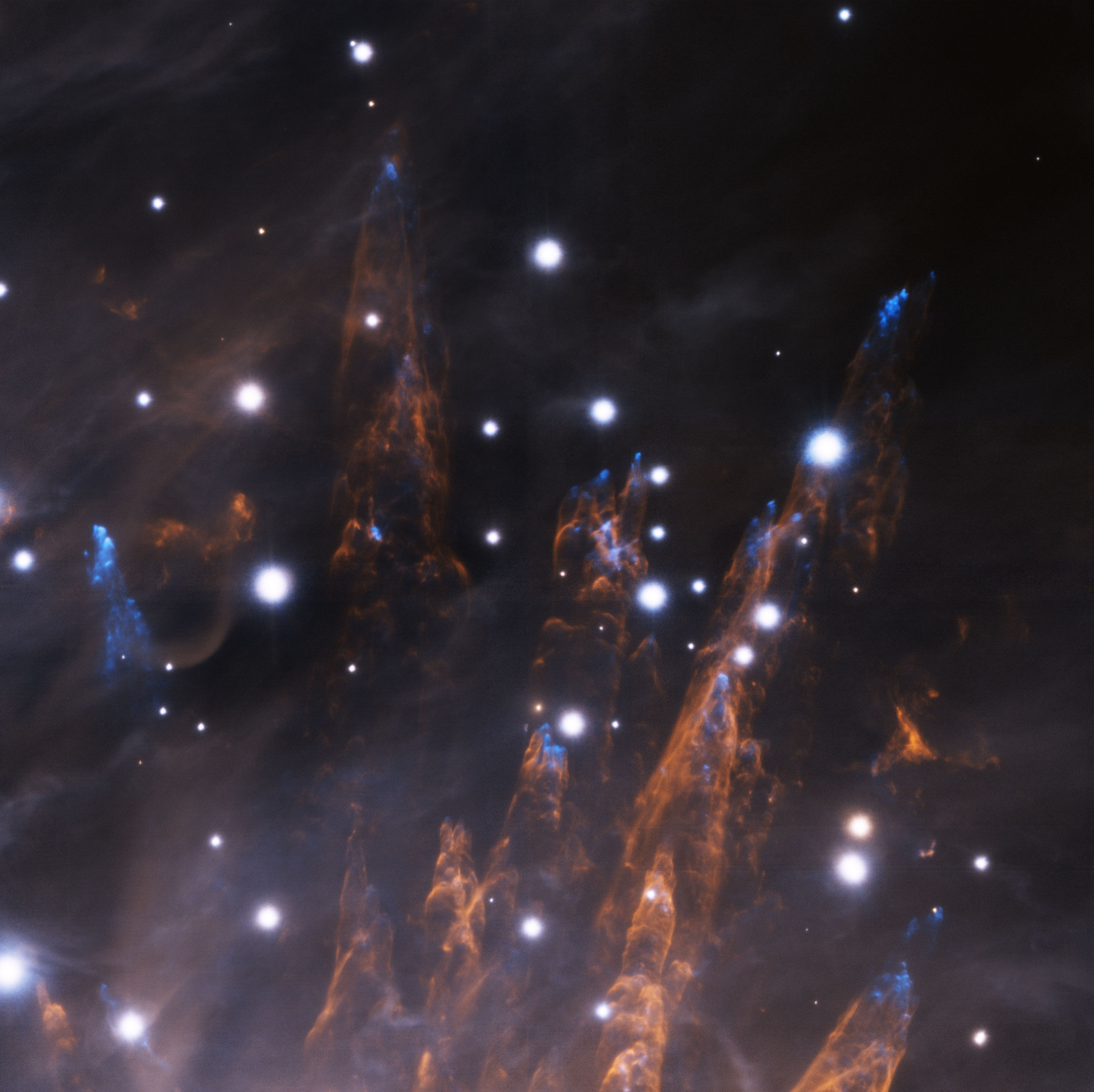
The Orion bullets are ejecta of mostly iron gas in the Orion Nebula moving at about 170 kilometers per second (about 380,000 mph or more than 1/2000 the speed of light). They're also massive: larger than ten times the diameter of Pluto's orbit around the sun. Their wakes are hydrogen ionized (and therefore glowing) as the bullets moved through.

The recent high res image of the cluster (shown at left, click through on link for full image) was taken by the Gemini South Observatory at La Serena, Chile. The mirrors on the telescope are deformable to correct for atmospheric distortion which is measured from aberrations in the laser light from five guide stars.

Just all so very cool. (Oh, while we're at it, here's a selection of great photos of the Orion nebula.)

Sunday, January 13, 2013

The Fermi Paradox and the Logic of a Tapeworm

The "Fermi Paradox" was an assertion by famous physicist Enrico Fermi that if intelligent life exists elsewhere in the Universe it would have visited Earth already. Since it hasn't it must not exist.

It is, obviously, silly. It makes assumptions without evidence as to the ease of travel between star systems, the large prevalence of life elsewhere if it exists at all, the widespread desire of other lifeforms to visit Earth, and at its heart it misunderstands (indeed, sort of makes a mockery of) positivism as a scientific principle.

Boing Boing links to a post by Charlie Stross on his blog Charlie's Diary that takes Fermi's paradox apart imagining it as the philosophy of a tapeworm wondering if there are other tapeworms. It is, in Stross's words, "the Fermi paradox, mired in shit." He takes apart its errors point by point.

What we know of the world is well reasoned conjecture based on observation. The observations on which the conjecture that life exists elsewhere in the Universe are the scale of the Universe, the number of galaxies and stars it contains, the likelihood that Earth-like planets exist, and what we know of the circumstances where life could arise. Life elsewhere, somewhere, seems likely.

Thursday, January 3, 2013

An Incredible Fact: The Deadliest Fire in U.S. History Happened the Same Day as the Great Chicago Fire but was in Wisconsin

Image from a mural at the Peshtigo Fire Museum
October 8, 1871, was an incredibly bad day for disasters in U.S. History. In Chicago the Great Chicago Fire began and over two days burned through the center of the city up to the northside. It ended at Lake Michigan and killed several hundred, rendering homeless a hundred thousand, and destroying about 1/3 of the property, by value, in the City. Although the fire did begin, as in legend, at the O'Leary's barn, the actual cause is unknown. The O'Leary's house, south of their barn, was unscathed.

In Wisconsin that same day another fire broke out in the forest north of Green Bay. (N.B. Green Bay is about 210 miles (c. 335 km) due north of Chicago -- this was a completely separate fire.) There had been a drought that summer with only a few inches of rain (this also affected Chicago), and there were very strong winds blowing out of the southwest towards the northeast (again, same in Chicago). This led to the formation of a massive wall of flame which rapidly moved northeast scorching the forest killing hundreds and 900 to 2000 (estimates vary) as it blew through the town of Peshtigo, Wisconsin, and surrounding villages until exhausting itself at an inlet of Lake Michigan.

Wednesday, January 2, 2013

How We Know the Earth is a Sphere

And after these things I saw four angels standing on the fourcorners of the earth, holding the four winds of the earth, that the wind should not blow on the earth, nor on the sea, nor on any tree.
Revelation 7:1-3

Yes, yes, it's like shooting fish in a barrel, but still it is valuable to consider how we know things:


I would add we know the Earth is not flat for many other obvious reasons, like, if it were flat gravity would be markedly greater in its center, tidal forces would tear the Earth apart, meteorites or comets could make holes the Earth (depending on how thick the Earth was and how large the meteorite or comet), seismological tests would not make any sense (since they disprove the flat Earth), plate tectonics would not make much sense, satellites would not orbit the Earth in the manner they do ... we could just go on and on.

Friday, December 28, 2012

In Focus's Hubble Space Telescope Advent Calendar

Every year Alan Taylor, formerly the editor of the Boston Globe's The Big Picture and now the editor of The Atlantic's In Focus, posts pictures from The Hubble Space Telescope leading up to Christmas.  Well, I got busy, what with sleigh repairs and everything, so, here you go a little late (click through for the full set of images, which are great) and here are some links to his prior advent calendars. The shots he selects are always beautiful and incredible.


Monday, November 26, 2012

Night Sky, France, Leonid Meteor, Beautiful

Via Colossal. Best viewed full screen


Well, you only know it's France due to the music. French videos are evidently required to have this music.

Wednesday, November 21, 2012

And I Said a Manned Space Ship will Never Go to Another World (in our lifetimes)

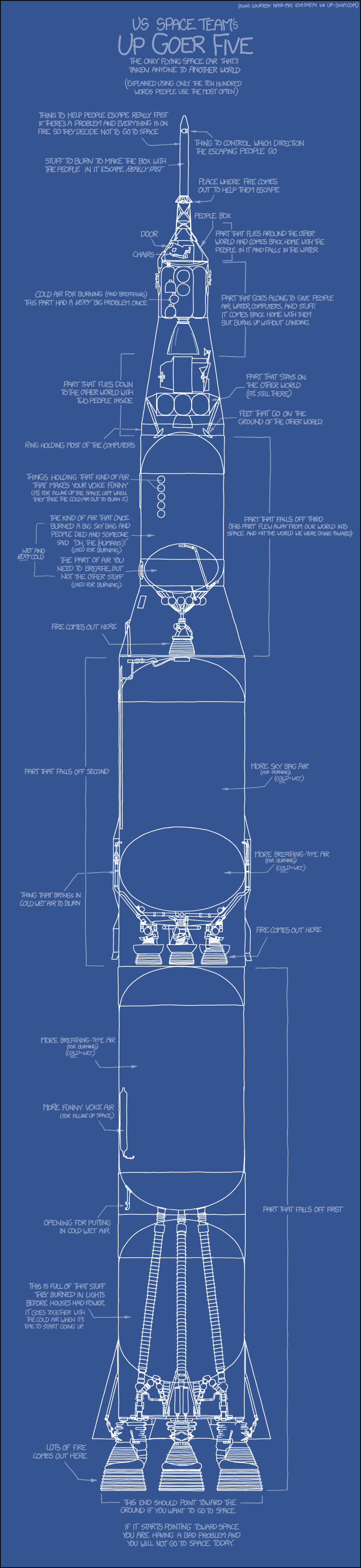
National treasure Randall Monroe has drawn a sketch -- a huge sketch -- of the Saturn V rocket with Apollo module attached and posted it on his website xkcd. The drawing is based on blueprints of drawings of the Saturn V from the web site found at the web site up-ship.com except that Monroe translates the engineering-ese into cool and funny plain-people-ese.

But I'm still sad about the stars.

Sunday, November 4, 2012

NASA's Fermi Gamma Ray Telescope Has Completed its Primary Mission of Measuring the "Fog" of Ancient Starlight

Light measured across the visible Universe; the green dots are blazers (see below) 
Per NASA (on Thursday, November 1):
Astronomers using data from NASA's Fermi Gamma-ray Space Telescope have made the most accurate measurement of starlight in the universe and used it to establish the total amount of light from all of the stars that have ever shone, accomplishing a primary mission goal.

"The optical and ultraviolet light from stars continues to travel throughout the universe even after the stars cease to shine, and this creates a fossil radiation field we can explore using gamma rays from distant sources," said lead scientist Marco Ajello ... .

Friday, October 26, 2012

A 9 Billion Pixel Image of the Milky Way from ESO

The European Southern Observatory has just released a massive 9 billion pixel image of the Milky Way made from a composite of photos taken by the Visible and Infrared Survey Telescope for Astronomy ("VISTA") at the Paranal Observatory in Chile. This is the largest most detailed image of the Milky Way ever taken. The version below, expanded, is a measly 380 KB (~1.2 million pixels). It's not grainy; those are stars.

Thursday, October 25, 2012

NGC 2623, Just Because This is Beautiful

NGC 2623 is two merging galaxies only 300 million light years away from us. If we leave now they should be all merged by the time we get there. From Astronomy Picture of the Day, the Hubble Legacy Archive, and the European Space Agency.

Wednesday, October 17, 2012

Stunning Discovery Reveals Earth Sized Planet Only .00000443 Light Years Away From Earth!

**PRESS RELEASE**PRESS RELEASE**PRESS RELEASE**

While the astronomical world was abuzz today with the discovery of an Earth sized planet "only 4.3 light years from Earth," dubbed Alpha Centauri Bb, Galileo Feynman announced his discovery of an Earth sized planet one million times closer.  He is calling the planet “Venus.”

"Venus" is only.00000443 Light Years Away From Earth.

Scientists are excited about the possibility of colonizing Alpha Centauri Bb which, according to Space.com, has a surface temperature of 2,240 degrees Fahrenheit. Feynman asserts the temperature of his so-called “Venus” is substantially below 1,000 degrees Fahrenheit. “While colonization of Alpha Centauri B b is certainly a good idea for its discoverers,” Feynman said, “we may want to send others to Venus first.”  He listed a series of prominent Republicans and pundits.

Although The New York Times says the discovery of Alpha Centauri B b brings "the search for another Earth about as close as it will ever get," Feynman speculates that there are other small planets much closer to earth. In addition to his so called "Venus," he named other potential planets "Mars" and "Mercury," suggesting that we might have already landed one or more probes on them. In a flight of fancy, he also suggested that some huge planets near Earth might have moons of their own which would be colonization candidates. He offered suggested names of "Titan" and "Europa." Space colonization, of course, is inevitable.

Tuesday, October 16, 2012

Video from "Stacked" ISS Images

The ISS "Stacks" from Christoph Malin on Vimeo.

This video was made by "stacking" images taken from the International Space Station and then, apparently, processing them so they would run smoothly as a video.  Although frame stacking is a common practice in both astrophotography and HDR photography, I am not clear how it was applied here -- the explanation at Vimeo by the Christoph Malin, the principal creator, is too cryptic, though I assume it involved registering and overlaying video sequences.  Some of the photos or underlying video are from astronaut Don Pettit, whose incredible photos I posted on before.

Happening Science

I've noticed a slew of interesting science news stories in the last few days.  The New York Times has reports on the rapid developments in growing artificial organs, the developments by chemist Paul Chirik of Princeton that allow iron and to be used in place of platinum as a catalyst in certain reactions (and a similar process that allows cobalt to be used as a catalyst in making plastic), and on confirmation that a meteorite that fell last year in Morocco came from Mars.  And then there's this cool video, via Physics arXiv, showing that liquid droplets hitting a pool will sit on the surface and no coalesce if the surface is vibrating:


The world is simply cool (and getting cooler).

Monday, October 8, 2012

Voyager 1 At the Edge of the Solar System

Via MetaFilter, a really nice if short article from the Houston Chronicle's science blog about Voyager 1's exit or impending exit from the solar system. The test that has been adopted for "leaving the solar system" is evidence of:
  1. An increase in high-energy cosmic rays originating from outside our solar system 
  2. A drop in charged particles emanating from the sun.
  3. A change in the direction of the magnetic field.
At the end of August there was a sharp sustained drop in the charged particles from the sun.  There's some of evidence of the first and third conditions having been met as well, though it's not definitive. "Leaving the solar system," though not sharply defined, is seminal; it will mark Voyager as not just the farthest humans have ever sent a machine, but as the first machine from Earth to travel between the stars. It's taken 35 years to get to our solar system's edge.