Showing posts with label Biology. Show all posts

Thursday, May 1, 2014

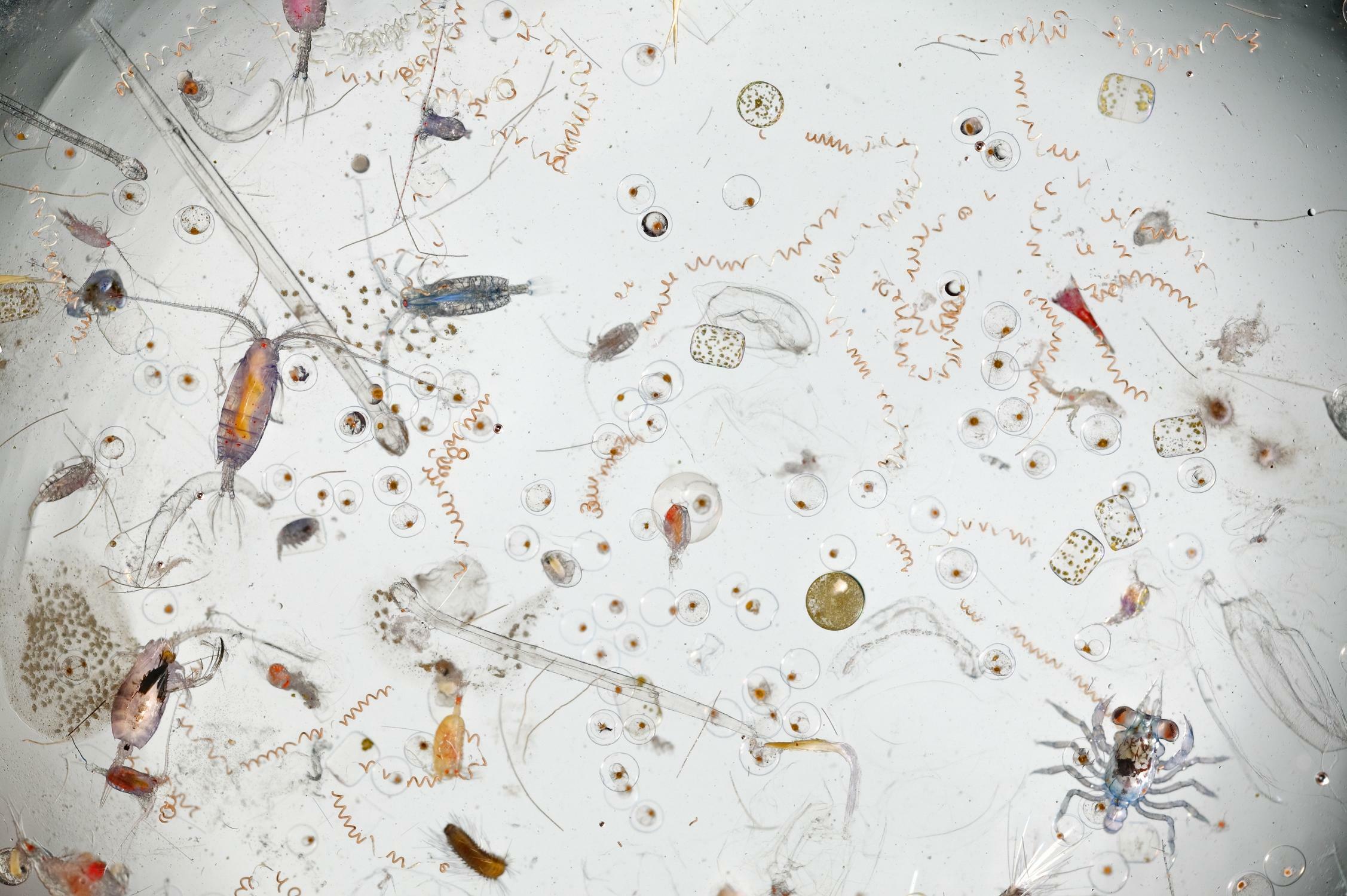
Yum, Delicious Seawater


Seawater (possibly from Moorea, French Polynesia?) magnified 25x, taken by David Liittschwager.  Link via Colossal. LARGE IMAGE HERE.

Friday, March 28, 2014

Slow Life from Daniel Stoupin on Vimeo


Via Kottke, on Vimeo. As Daniel Stoupin, the creator, states at his blog and his Vimeo description accompanying his video, he required 150,000 "shots" to make this 3 minute and 38 second video, and most of it involves image stacking to give a greater depth of field.  He suggests it be watched in full HD (it has 4K resolution) on a large screen with actual image size selected.  He also asks that it not be used for sales purposes, particularly for the marine aquarium industry (not that he has any antipathy with that industry, he just doesn't want it used for its sales).  The underlying thrust of the video is that much marine life (heck, much life in general) moves at scales humans are not accustomed to appreciate yet it is extremely important to our well being.

Friday, January 10, 2014

Thursday, November 14, 2013

The "Lego Insect Collection" by Seircon and Coral

Over on Flickr there's a really great set of Lego insects made by Sean and Steph May (who go by Seircon and Coral).  A few samples:


Monday, April 1, 2013

Sunday, March 31, 2013

Saturday, March 16, 2013

The Incredible Underwater Photography of Alexander Semenov

Alexander Semenov, a Russian zoologist specializing in squid, started taking underwater photographs a few years ago, and his work has simply taken off. Below a selection of close-ups of coral. His site is worth going through for a full selection of his work (or just see my prior post on his photos -- not not really, go to his site).

Life on the Ol' Wabash


This, I am given to understand, is how people in Indiana spend their time.

Thursday, February 7, 2013

Infrasounds and Homing Pigeons

Diagram A shows all releases and random directions pigeons flew; diagrams B,
C, D, and E show different release dates; dashed lines are the correct direction
While we're talking about pigeons, yesterday The Atlantic had an interesting piece about the disappearance of homing pigeons -- who are excellent navigators -- when released from one specific location. One day, though, they flew home with no problem.

After years of not being able to answer the question, the answer has been recently published in The Journal of Experimental Biology: it's infrasounds. Much as human perception is limited to a narrow range of light waves, our hearing is limited to a narrow range of sound. While humans can hear sounds to  ~ 20 hertz, pigeons can hear sounds as low as .05 hertz.

The ocean (or sounds resulting from the ocean) apparently is the dominant source of sounds at that low level even hundreds of miles from the sea. Topography, wind speed and direction, and temperature, however, affect sounds, allowing pigeons to navigate. They also, however, leave dead zones (and surely also places where sound is greatly amplified). The location where the pigeons got lost was normally a dead zone. The one day they didn't get lost was one day where likely high level and not readily apparent atmospheric conditions filled it with sound and allowed the pigeons to find their way.

Pigeon navigation, then, requires not only the ability to hear these sounds but the ability to make a mental map (or remember the sounds they've heard) on one hearing to guide their way back. It's not a common human skill, even for for visual cues.

DNA Variations and the Diversity of Pigeons

The New York Times has an interesting science article on genome sequencing of pigeon DNA, which is being used to study how a few genetic variations can lead to great diversity of species (there are over 130 species of pigeons and doves, which are a form of pigeon). The article is a font of interesting factoids, such as the practice of Charles Darwin and Thomas Jefferson each in raising pigeons; the use by those as diverse as the ancient Greeks to Genghis Khan of pigeons as messengers, the fact that Akbar the Great always traveled with a colony of 10,000 pigeons. The NYT's article arises from an article in Science, which traced the genetic variations of pigeon DNA (and confirms, among other things, that the progenitor is Rock Pigeons, as Darwin thought).

Interesting as all of that is, what I liked most about the article was its photo spread on pigeon variations, which was rally beautiful. It's worth clicking through to. (A few examples below.)

Tuesday, February 5, 2013

Today's "Horror" Story

Today's horror story is actually an ancient horror story ... for insects. Cordyceps, a fungi that eats the brains and bodies of insects, is claimed to have medicinal value (particularly in traditional Chinese medicine), but there are no clinical studies demonstrating health benefits in humans. Anyway, here's a "nice" video from the BBC's Planet Earth series, making cordyceps reminiscent of the "earwigs" from the Night Gallery episode The Caterpillar (which, in all its creepiness, can be seen on YouTube -- 1, 2, 3, 4 -- about 40 minutes total). And, of course, humans are prone to worms in our brains (not a link to Rush Limbaugh). Yuk.


Video seen on Cynical C.

Monday, February 4, 2013

In Office Full Genomic Analysis

I posted about two weeks ago about an interview at Spiegel Online with Harvard biologist George Church who asserts that DNA not only soon can but will be used to create synthetic Neanderthals and other animals, as well as changing individual's genomes, and even will be used to design machines. (A follow-up post a few days later reported on two very promising studies in the use of DNA, particularly as a memory device for computation.)

Dr. Church, it turns out, has been very busy.

As reported in The New York Times, Knome, a company he co-founded and for which he is the chief scientific adviser  has just released a full genome sequencer that is the size of a file cabinet and costs about $125 K. It used to cost $250 K to sequence the full genome of one individual. In short, this is a pretty incredible development.

The science of DNA engineering is moving ahead extraordinarily fast -- must faster than our culture.

Sunday, February 3, 2013

Synthetic Crystals Acting (Sort of ) Like Living Organisms


This video (which I originally saw at Neatorama) shows particles of hematite (Fe2O3) which, at the nanoscale, has magnetic properties that are less pronounced in larger sample (actually raising the temperature changes the magnetic properties of hematite). In the video the particles are partially covered with a polymer and are in a bath of hydrogen peroxide; when the light is "on" the particles conduct electricity and react with the hydrogen peroxide but are easily disturbed and move around. When the light is "off" they stop reacting, jiggling with what appears to be Brownian motion.

The video with the light "on" is reminiscent of Conway's famous "game of life" simulation.

"Speak Memory" -- Oliver Sacks on the Validity and Shortcomings of Human Memory in The New York Review of Books

In 2001 Oliver Sacks, the great neurologist and author, published a book of memoirs named Uncle Tungston: Memoirs of a Chemical Boyhood. Shortly after its publication he learned from speaking with his brother Michael that he was not present one of the vivid incidents he "recalled" but that it came fro a letter another wrote. With that Sacks sends us on a short and fascinating odyssey on memories that are found from others, on “cryptomnesia.”

We are reminded (if you will) of the famous incident where Ronald Reagan described as historical fact a movie scene he remembered; George Harrison's likely unintentional copyright infringement in My Sweet Lord of Ronnie Mack's He's So Fine; Helen Keller's alleged (and plainly unintentional) plagiarism of a children's author when Keller was 11 (and Mark Twain's very kind letter to Keller about it, describing inadvertently plagiarizing Oliver Wendell Holmes, Sr.); of charges of plagiarism that were leveled against Samuel Taylor Coleridge, whose memory was so prodigious he probably could not have helped but had cryptomnesia; and of Sack's being inadvertently plagiarized himself. Throughout there is a recurrent and compelling narrative that cryptomnesia is very common for all of us. This may present issues when we wonder what is real (it doesn't mean reality doesn't exist or that different memories are equally true, of course), and it presents fascinating questions as to how cryptomnesia occurs and how it can be measured. Sacks, in fact, while writing an article stronger on story than underlying science, cites to several writings worth further review.

Equally significant -- indeed, most significant from my perspective as a lawyer -- is how how unreliable witness memories are. We rely, by necessity it seems in many cases, on what people describe from the stand, and what they say is often very in accurate. Of course, sometimes witnesses lie straight-out (and are rarely prosecuted for this, by the way). But very often a witness convinces himself that an invented story is true. How can that happen? We suspect it is because they feel a need for some story; that the story they offer has some emotional purpose for them; or that perhaps it has been suggested. What we lack are realistic ways to examine their truthfulness. Short of that, witness testimony is accepted too readily, and it leads to real and substantial harm for many people.

I don't think we can abandon witness testimony. What we need are scientific, established criteria to measure its validity.

Saturday, February 2, 2013

A Real-Time Visualization of a Zebra Fish's Response to Food

Said to be the first video of its kind, Japanese researchers have videotaped neuronal response to a stimulus -- specifically, the neuronal response of a larval zebrafish in response to food. So, here's it is:


That's actually a short segment. A longer, more descriptive video abstract can be found here (on site select tab for video -- it's not embedable). Here they describe their work (from their written abstract):
To understand how the brain perceives the external world, it is desirable to observe neuronal activity in the brain in real time during perception. The zebrafish is a suitable model animal for fluorescence imaging studies to visualize neuronal activity because its body is transparent through the embryonic and larval stages. ... Here we demonstrate visualization of neuronal activity in the optic tectum of larval zebrafish by genetically expressing the new version of GCaMP [a calcium indicator]. First, we demonstrate [calcium] transients in the tectum evoked by a moving spot on a display and identify direction-selective neurons. Second, we show tectal activity during perception of a natural object, a swimming paramecium, revealing a functional visuotopic map. Finally, we image the tectal responses of a free-swimming larval fish to a paramecium and thereby correlate neuronal activity in the brain with prey capture behavior.
Exciting!

Monday, January 28, 2013

Tarsier Facts

From the inestimable Ze Frank, via Miss Cellania, 


As to the tarsier's innocent wide-eyed appearance, well you might watch this short clip (from the BBC's Life and narrated by the wonderful and ubiquitous and also inestimable David Attenborough). To quote, in part: "Tarsiers are the only totally carnivorous primates on Earth." (Okay, Ze Frank says this, too, and sounds like Morgan Freeman, but he probably got it from Attenborough, who sounds like Attenborough.)

Sunday, January 27, 2013

"Glass Microbiology" by Luke Jerram

"Glass Microbiology" by Luke Jerram, and incredible colorblind artist, consist of blown and shaped glass sculptures in the form of viruses and bacteria. They are vaguely -- very vaguely -- reminiscent for me of the incredible glass flower collection at Harvard created at the end of the 19th century to aid in the study of botany.

Jarem, by the way, has a substantial body of other beautiful and thoughtful sculptural and glass work. Here's a few examples of his glass microbiology work (more below break) or by clicking on any picture):

E. coli

Saturday, January 26, 2013

Fuck Yeah Dinosaur Art

Fuck Yeah Dinosaur Art is a tumblr blog I noticed from somewhere -- I think the awesome tumblr Scientific Illustration, but I can't find the link back -- but anyway, Fuck Yeah Dinosaur Art is fun to look at and often funny. Samples from some of its most recent posts:

Friday, January 25, 2013

Beyond Synthetic Neanderthals: Synthetic DNA Computers

I posted a few days ago about Harvard biologist George Church's views about the likelihood that Neanderthals will be created/born in the foreseeable future and that DNA techniques will ultimately to design machines and devices. Admittedly those views seem farfetched (as well as presenting ethical issues). Anyway, now comes news in the leading peer reviewed  journal Nature of the development of "practical, high-capacity, low-maintenance information storage in synthesized DNA." To quote the summary:
Previous DNA-based information storage approaches have encoded only trivial amounts of information or were not amenable to scaling-up, and used no robust error-correction and lacked examination of their cost-efficiency for large-scale information archival. Here we describe a scalable method that can reliably store more information than has been handled before. We encoded computer files totalling 739 kilobytes of hard-disk storage and with an estimated Shannon information of 5.2 × 106 bits into a DNA code, synthesized this DNA, sequenced it and reconstructed the original files with 100% accuracy. Theoretical analysis indicates that our DNA-based storage scheme could be scaled far beyond current global information volumes and offers a realistic technology for large-scale, long-term and infrequently accessed digital archiving.
The idea of DNA based computers is not new. This study shows a significant step in this direction, and that regardless of computing methodology biologic based encoding seems a very good method for digital memory.

A bonus note: as to the history of computing (including memory methods), this video from 1983 is very cool.

Tuesday, January 22, 2013

Synthetic Neanderthals

In an interview at Spiegel Online (Deutsch link) Harvard biologist Georgia Church explains (English link) discusses how recombinant DNA/stem cell techniques could in the near future lead to neanderthals being created/born:
Church: The first thing you have to do is to sequence the Neanderthal genome, and that has actually been done. The next step would be to chop this genome up into, say, 10,000 chunks and then synthesize these. Finally, you would introduce these chunks into a human stem cell. If we do that often enough, then we would generate a stem cell line that would get closer and closer to the corresponding sequence of the Neanderthal. We developed the semi-automated procedure required to do that in my lab. Finally, we assemble all the chunks in a human stem cell, which would enable you to finally create a Neanderthal clone.

SPIEGEL: And the surrogates would be human, right? In your book you write that an "extremely adventurous female human" could serve as the surrogate mother.

Church: Yes. However, the prerequisite would, of course, be that human cloning is acceptable to society.
That this is possible and in the relatively near future will be feasible is not news. Biologist PZ Myers of the very widely read blog Pharyngula gets all stinky about the ethics of this.