Showing posts with label Cycle of Life. Show all posts

Thursday, May 1, 2014

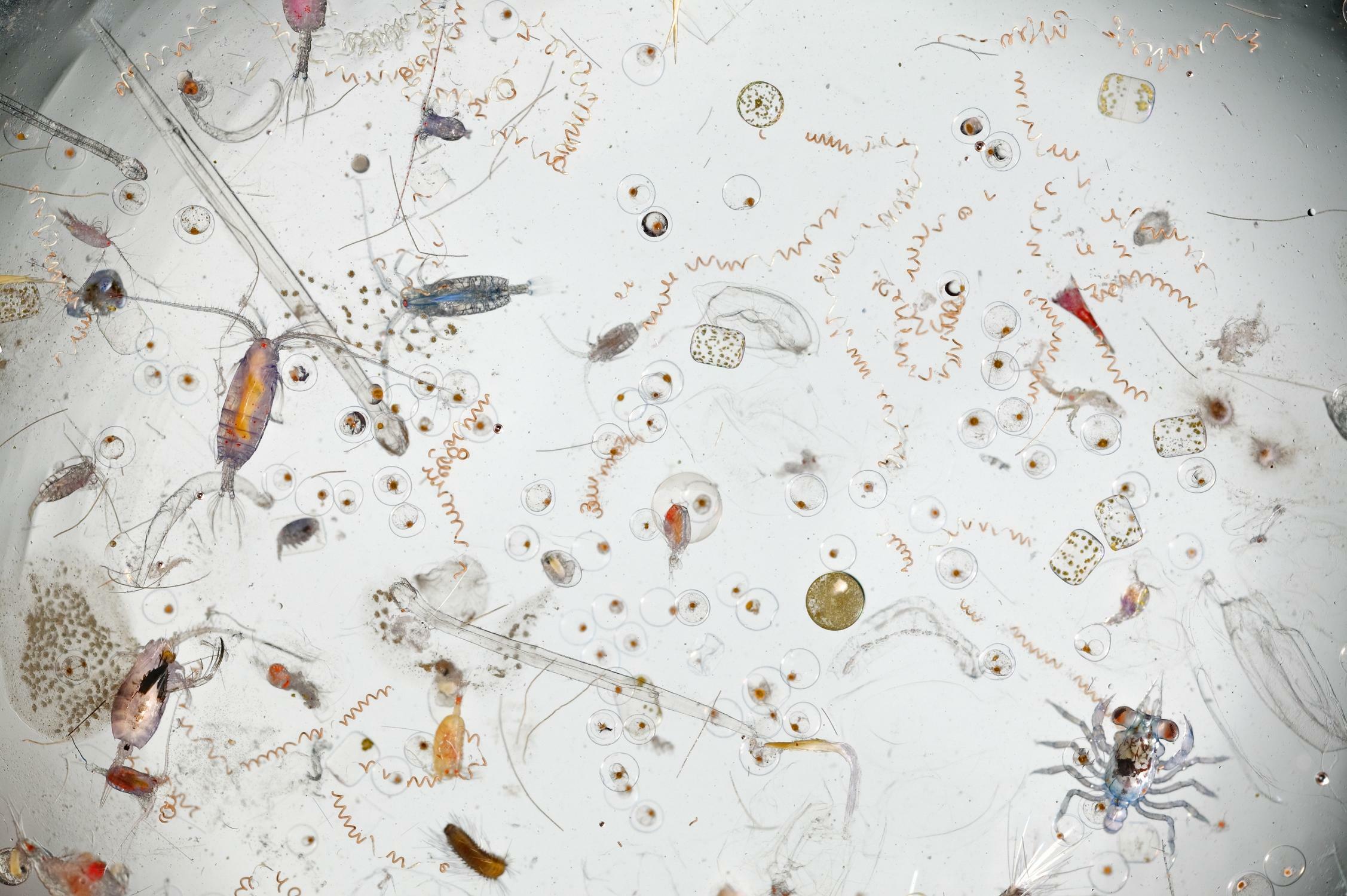
Yum, Delicious Seawater


Seawater (possibly from Moorea, French Polynesia?) magnified 25x, taken by David Liittschwager.  Link via Colossal. LARGE IMAGE HERE.

Friday, March 28, 2014

Slow Life from Daniel Stoupin on Vimeo


Via Kottke, on Vimeo. As Daniel Stoupin, the creator, states at his blog and his Vimeo description accompanying his video, he required 150,000 "shots" to make this 3 minute and 38 second video, and most of it involves image stacking to give a greater depth of field.  He suggests it be watched in full HD (it has 4K resolution) on a large screen with actual image size selected.  He also asks that it not be used for sales purposes, particularly for the marine aquarium industry (not that he has any antipathy with that industry, he just doesn't want it used for its sales).  The underlying thrust of the video is that much marine life (heck, much life in general) moves at scales humans are not accustomed to appreciate yet it is extremely important to our well being.

Wednesday, July 24, 2013

Monday, January 28, 2013

Tarsier Facts

From the inestimable Ze Frank, via Miss Cellania, 


As to the tarsier's innocent wide-eyed appearance, well you might watch this short clip (from the BBC's Life and narrated by the wonderful and ubiquitous and also inestimable David Attenborough). To quote, in part: "Tarsiers are the only totally carnivorous primates on Earth." (Okay, Ze Frank says this, too, and sounds like Morgan Freeman, but he probably got it from Attenborough, who sounds like Attenborough.)

Monday, January 14, 2013

Organisms with Super Powers?

Hey, these aren't super powers; it's biology! Anyway, the blog Southern Fried Science has a popular post on five organisms who have "powers" similar, in the author's view, to the super powers of comic book heroes. You've got Bdelloid rotifers that are unisexual and caeable for going dormant for extraordinary periods and can survive in space and when they come out of dormancy in a new environment can absorb DNA or local organisms adapting to the new environment. You've got a deep sea snail that can absord iron sulfide into its shell and foot, making them metallic and aiding their survival at great depths. You've got the parasitic barnacle Sacculina which takes over the blue crabs sexual system replacing it with its own, changes the crabs mating behaviors to mate with other crabs infected with Sacculina, and, if the infected crab was a male it will change its sex to make it a female to care for the Succulina's eggs, which grow on the crab. Then you've got octopi whose ability to shape shift is now well known from numerous videos. And you've got black mold that was altered by radiation at Chernobyl and now "feeds" on radiation.

That actually is a tiny fraction of the weird and incredible things that organisms on Earth do that seem like super powers. And, while the Sacculina parasite may gross me you out, its about the tip of gross parasites. Hey, here's a video of a roundworm emerging from the stomach of a dead spider. Um, enjoy!

Friday, January 11, 2013

RIP Whiskers

Via Boing Boing. I don't know whether this is a hoax, either (I am going to guess no on this one). Whiskers, we hardly knew ya.

Wednesday, December 19, 2012

Eagle Attempting to Take a Child

Update: The video is now asserted on some good authority -- well, Gawker, so that has its own problems -- to be a fake. (We stand by our original "if legit" comment, below.)
______________________

This, if legit, is a bit scary. If that kid weren't so chubby ...


Wait, not scary? Well, then, there's this article from National Geographic.

And, yes, the choice of music over the slo-mo is a bizarre and inscrutable. Video via MetaFilter.

Sunday, December 9, 2012

I'm Creeped Out (But Fascinated)

Image and caption from New York Times: When infected by
thorny-headed worms (the orange spot), gammarids swim
toward light. At the water's surface they become easy prey
for birds, the next creature the worm needs to infect to
complete its life cycle.
From The New York Times on Wednesday (to my attention via MetaFilter):
In the rain forests of Costa Rica lives Anelosimus octavius, a species of spider that sometimes displays a strange and ghoulish habit.

From time to time these spiders abandon their own web and build a radically different one, a home not for the spider but for a parasitic wasp that has been living inside it. Then the spider dies — a zombie architect, its brain hijacked by its parasitic invader — and out of its body crawls the wasp’s larva, which has been growing inside it all this time.

        * * *
[T]he new web is splendidly suited to its wasp invader. Unlike the spider’s normal web, mostly a tangle of threads, this one has a platform topped by a thick sheet that protects it from the rain. The wasp larva crawls to the edge of the platform and spins a cocoon that hangs down through an opening that the spider has kindly provided for the parasite.

To manipulate the spiders, the wasp must have genes that produce proteins that alter spider behavior, and in some species, scientists are now pinpointing this type of gene. ...
The New York Times article is written to draw attention to a new issue of The Journal of Experimental Biology which is dedicated to the subject of neural parasitology. The 18 or so articles at the issue are free. And, as the New York Times note, the issue of parasites (including viruses) taking over their hosts and substnatially altering their behavior is neither new nor rare -- it is a widespread phenomena.

It is also fact that makes arguments about whether "free will" exists or not silly (it's a nonsensical concept).

Wednesday, December 5, 2012

So, I am Wondering What the Tort Laws are in Russia


And my kids complain about my driving. Look, I gave doing the crossword while I drive (really, they made me do that), and very few of these incidents look familiar. (I'm actually embarrassed to be posting this video, but, this is just so incredible ... anyway, via Kottke.)

Tuesday, October 30, 2012

The Gashlycrumb Tinies

One of the great works of abecedarian literature, The Gashlycrumb Tinies remain a hallmark of our society's attainment and a continued source of hope for our future. I am loathe to reproduce the entire set here, and instead point you to your doom the link in the last sentence. Farewell.

Friday, July 27, 2012

Exploding Termites

According to an article on the website Science Now (the website/magazine for the American Association for the Advancement of Science), scientists studying termites in French Guiana found a species with "blue crystals" in what looks like the anterior of their abdomens, see image) that "explode" when touched. the explosion releases an enzyme that becomes toxic when combined with certain proteins, ostensibly those of attackers. Only aged termites in a colony have the crystals; thus, the aged apparently commit suicide to repel attackers.