Showing posts with label Environment. Show all posts

Thursday, February 7, 2013

Infrasounds and Homing Pigeons

Diagram A shows all releases and random directions pigeons flew; diagrams B,
C, D, and E show different release dates; dashed lines are the correct direction
While we're talking about pigeons, yesterday The Atlantic had an interesting piece about the disappearance of homing pigeons -- who are excellent navigators -- when released from one specific location. One day, though, they flew home with no problem.

After years of not being able to answer the question, the answer has been recently published in The Journal of Experimental Biology: it's infrasounds. Much as human perception is limited to a narrow range of light waves, our hearing is limited to a narrow range of sound. While humans can hear sounds to  ~ 20 hertz, pigeons can hear sounds as low as .05 hertz.

The ocean (or sounds resulting from the ocean) apparently is the dominant source of sounds at that low level even hundreds of miles from the sea. Topography, wind speed and direction, and temperature, however, affect sounds, allowing pigeons to navigate. They also, however, leave dead zones (and surely also places where sound is greatly amplified). The location where the pigeons got lost was normally a dead zone. The one day they didn't get lost was one day where likely high level and not readily apparent atmospheric conditions filled it with sound and allowed the pigeons to find their way.

Pigeon navigation, then, requires not only the ability to hear these sounds but the ability to make a mental map (or remember the sounds they've heard) on one hearing to guide their way back. It's not a common human skill, even for for visual cues.

Monday, January 7, 2013

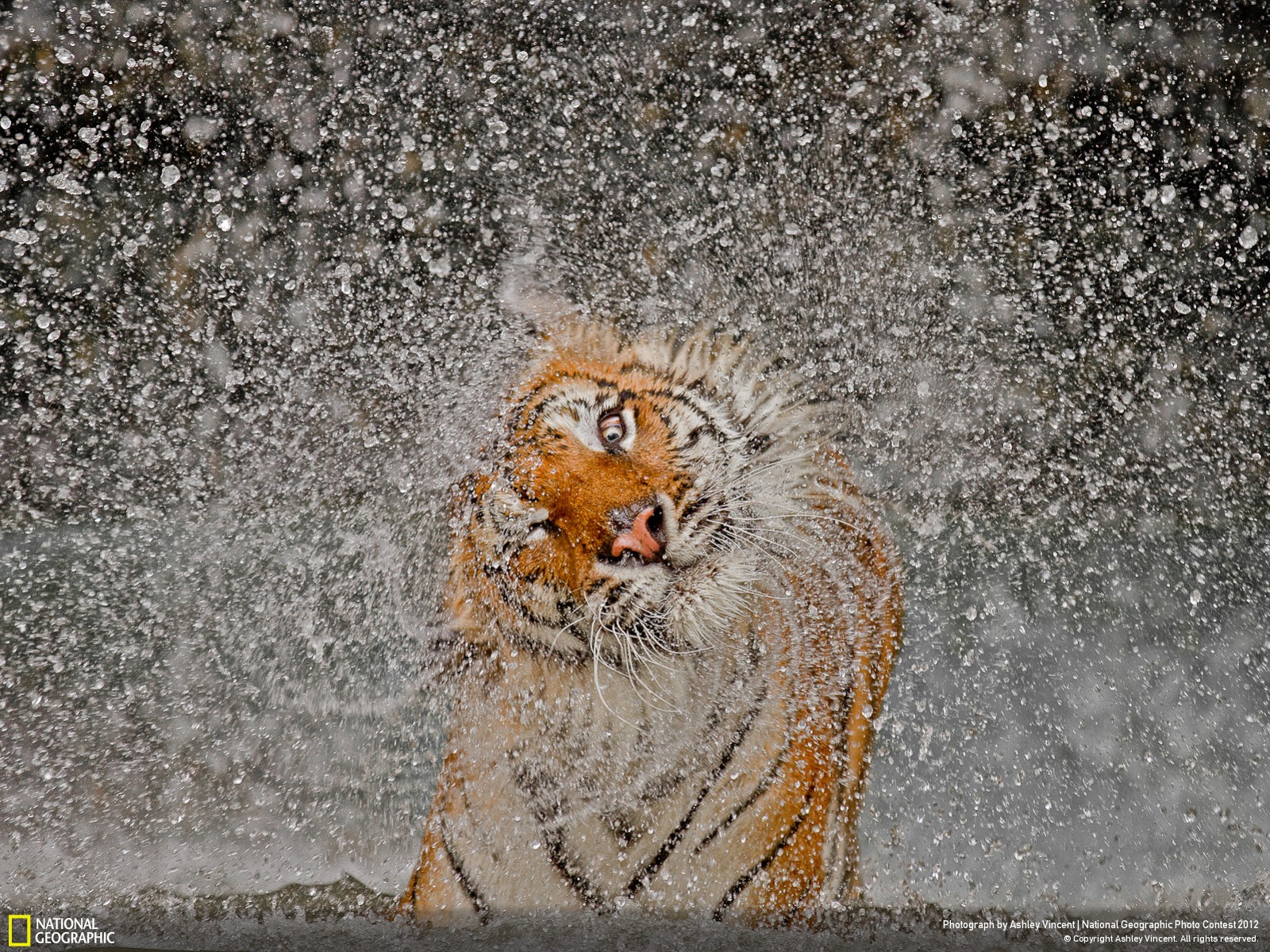
National Geographic Photo Contest Winners ... At Last!

It's three weeks since National Geographic was scheduled to announce their photo contest winners .. and now that it has done so I admit I'm a little disappointed. These aren't bad photos -- they're great photos -- but the judges overlooked a lot from what they had to choose from, in my view. I've covered the entries previously, and I've linked at the end of this post to my collections of what I thought were the best photos of the 22,000 submitted. Ah well ...

Grand Prize and Nature Winner

Wednesday, December 19, 2012

From Slate: The Clean Water Act is One of the Greatest Successes in Environmental Law

From an article in Slate worth reading in full:
A river catches fire, so polluted that its waters have “no visible life, not even low forms such as leeches and sludge worms.” This could describe the mythological River Styx from Hades. Residents of Cleveland, though, may recognize the government’s assessment of their own Cuyahoga River in 1969. While hard to imagine today, discharging raw sewage and pollution into our harbors and rivers has been common practice for most of the nation’s history, with devastating results. By the late 1960s, Lake Erie had become so polluted that Time magazine described it as dead. Bacteria levels in the Hudson River were 170 times above the safe limit.

             * * *
In 1972, a landmark law reversed the course of this filthy tide. Today, four decades later, the Clean Water Act stands as one of the great success stories of environmental law. Supported by Republicans and Democrats alike, the act took a completely new approach to environmental protection. The law flatly stated there would be no discharge of pollutants from a point source (a pipe or ditch) into navigable waters without a permit. ...

Protecting our nation’s waters may seem like common sense today, but the idea of nationally uniform, tough standards against polluters was both original and radical. ...

             * * *
By many measures, the Clean Water Act has fulfilled the ambition of its drafters. The sewage discharges that were commonplace in the 1960s are rare. The number of waters meeting quality goals has roughly doubled. Once a convenient dumping ground for all manner of filth, rivers now represent an urban gem. Hartford, Conn.; Kansas City, Kan.; Cleveland; and other cities have based much of their redevelopment around their now clean and inviting waters, with waterfront parks and the lure of fishing and trails along the water’s edge.

             * * *
But the glass is only half full, for major challenges remain. The EPA estimates that about half of our rivers and streams, one-third of lakes and ponds, and two-thirds of bays and estuaries are “impaired waters,” in many cases not clean enough for fishing and swimming. ...

Tuesday, December 18, 2012

Now This is a Tree

Took this shot in the backyard yesterday -- I'm the guy in the red coat at the bottom. (Really, it's from National Geographic.)

Friday, December 14, 2012

National Geographic Contest Photos, Final Post of the 2012 Entries

Bringing us up to date, here are links to the prior posts (in reverse chronological order): here, here, here, here, here, here, here, here, here, here, and here. That, again, is about .5% of the total contest entries, most of which were pretty good photos (that is I've posted about 1 photo for every 200 that were entered in the contest).

Tuesday, December 11, 2012

For You MORE National Geographic Photo Contest Photos

I slept in this morning. So shoot me. Well, instead, here's some shots to inspire you:

Sunday, December 9, 2012

Winding Down the National Geographic Photo Sets

I've posted a lot of photos from the contest, but keep in mind that there were over 22,000 entries -- I've been through them all (and, trust me, that took some time) and am posting less then 1/2 of 1% of all entries -- the ones that I liked the best (and, sometimes, could find a large image of if that felt important). For credits, as always please look to the contest website (there are too many to repeat here, though the amateur photographers who made these shots deserve great credit).

Thursday, December 6, 2012

Photos from the National Geographic Photo Contest (continued)

I'm continuing to post some of the best photos (in my view) from the National Geographic photo contest. There were over 22,000 submissions, so posting here will continue for a few more days.

Tuesday, December 4, 2012

More from the National Geographic Photo Contest

A daily dose of photos from the National Geographic photo contest. All of the photos in this post expand to a very large wallpaper size by clicking on them.

Sunday, December 2, 2012

The National Geographic Photo Contest

National Geographic has closed entries to its photo contest for 2012. There are over 22,000. Over the next few days I'll be posting a few favorites (helped not only by going through the entries -- which is not easy given the number but by posts at such places as Colossal, The Big Picture, and In Focus). There are way too many to attribute specifics, which an be found at the National Geographic contest site.

Sunday, November 4, 2012

A Few Words on Global Warming, the Environment, and Governmental Regulation

Via Wikipedia
By now, few sane people could doubt that global warming is real. Debate, if any, might still be had, no matter how quibbling, over the causes -- is it primarily natural or man-made (frankly I don't doubt that there is a significant man-made component, but whatever)? -- and the long term consequences -- how big a problem is this (but almost all assessments, it's a huge problem)? Yet, regardless of debates of the causes or ignorance of all consequences, the reality of global warming results in some consequences that must be addressed. Regardless of debates, there are reasonable things we can do to reduce the problem.  The point, again, being that regardless of the extent of human cause, the problem must be addressed, regardless of knowing the full extent of the problem, some things still can be done.

Nonetheless, extremist Republican viewpoints and rhetoric are still preventing exercising any meaningfully solutions. Such a course, in my view, is irresponsible. Let us suppose that there is a basis to doubt the full extent of the problem or full human cause. Given the magnitude of the danger, the prudent thing to do is to act. This is not a speculative danger; this is one scientists overwhelmingly agree upon.

Tuesday, October 30, 2012

"Climate of Doubt"

Climate of Doubt is a Frontline documentary about the global warming skepticism "movement," which is a coordinated, highly financed attempt to sow doubt about the legitimate science and overwhelming consensus of climatologists about global warming. Meanwhile, Climatologist Michael Mann has sued The National Review and the Competitive Enterprise Institute for defamation due to comments they made about him and his work. The Competitive Enterprise Institute is a subject of Climate of Doubt.

Monday, October 22, 2012

"A Rogue Climate Experiment Outrages Scientists"

Via The New York Times:
A California businessman chartered a fishing boat in July, loaded it with 100 tons of iron dust and cruised through Pacific waters off western Canada, spewing his cargo into the sea in an ecological experiment that has outraged scientists and government officials.
       * * *
Marine scientists and other experts have assailed the experiment as unscientific, irresponsible and probably in violation of [international] agreements, which are intended to prevent tampering with ocean ecosystems under the guise of trying to fight the effects of climate change.

Though the environmental impact of the foray could well prove minimal, scientists said, it raises the specter of what they have long feared: rogue field experiments that might unintentionally put the environment at risk.
The businessman, Russ George, apparently sold his iron seeding services for $2.5 million to several coastal tribes. The theory was that they could claim carbon tax credits. That would appear unlikely. Calling it an "ecological experiment," given the absence of ability to measure results and the absence of controls, also seems unlikely.

Wednesday, September 19, 2012

Devil Fire

This photo by Chris Tangey and published at The Australian shows a dust devil sucking up a brushfire. The Australian will not allow me to look/link the photo on their site without registering and starting a "free trial period," so no link for you. Seen at boing boing.